(A Friendly, Humorous Explanation for the Chronically Confused)
Hey there, tech enthusiasts and lovely confused humans! 👋
If you’ve spent any time reading articles, listening to podcasts, or even just watching a futuristic movie, you’ve run into this acronym trifecta: AI, ML, DL.
Seriously, even the people who study these things sometimes have to look up the definitions! 😂 It’s a confusing, layered tech puzzle, and I promise you, you are not alone in being bewildered.
The short answer is that while they are related, they are not the same. Think of it like this: AI is the destination, ML is one of the vehicles you might use to get there. 🚗💨
Let’s break it down in a way that doesn’t require a degree in computational linguistics. Grab a cup of coffee, let’s go! ☕️
🧠 Part 1: What is AI? (The Big Goal)
If you could give the concept of “intelligence” to a machine, that’s what you would have.
Artificial Intelligence (AI) is the broadest concept. It is the theoretical concept of building a machine that can perform tasks that normally require human intelligence.
What does “thinking” mean in this context?
It means pattern recognition, problem-solving, decision-making, and adapting.
💡 AI is the umbrella term. It is the goal of creating a smart machine.
Examples of AI (The Super Smart Stuff):
- Siri/Alexa answering a complex query (understanding intent).
- A self-driving car navigating a messy street (planning a route).
- A recommendation engine (predicting what movie you want to watch).
✨ Analogy: AI is like giving your toaster the ability to write a sonnet. (Yes, it’s ridiculously smart, and probably pointless, but hey, it’s intelligent!)
📚 Part 2: What is ML? (The Learning Method)
This is where things get specific. Machine Learning (ML) is not a type of intelligence; it is a method or a technique used to achieve AI.
Instead of manually programming every single rule (e.g., “IF the picture has two pointed ears AND whiskers, THEN it is a cat”), ML allows the machine to learn those rules by itself, just by feeding it massive amounts of data.
The Core Idea: Data $\rightarrow$ Algorithm $\rightarrow$ Prediction.
ML machines don’t follow rigid instructions; they spot patterns. They are the digital equivalent of rote memorization and pattern spotting. 🤔
How it works (Simplified):
- You give the ML algorithm 1,000 pictures of cats (labeled “Cat”).
- You give it 1,000 pictures of dogs (labeled “Dog”).
- The algorithm studies the differences (size, shape, ear tilt, etc.) and figures out the patterns.
- Next time you show it a picture it’s never seen, it can confidently say: “Yep, that’s a cat! 🐾”
✨ Analogy: If AI is the smart brain, ML is the study technique. It’s the process of studying enough flashcards (data) until you can ace the test (make a prediction).
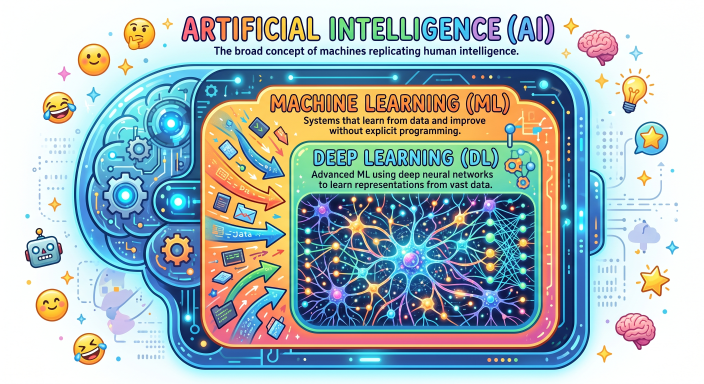
🚀 Part 3: Putting It All Together (The Relationship Diagram)
So, if AI is the goal, and ML is the method, where does this leave us?
The Simple Hierarchy:
AI > ML > DL
- AI (The Big Circle): The ambition. Making things smart. 🧠
- ML (The Medium Circle): The specific approach. Making things learn from data. 📊
- DL (The Tiny Circle): The specific tool within ML. Using complex neural networks to handle data patterns that are super complicated (like recognizing speech, or interpreting images). 🤯
🤖 The Car Analogy (The Easiest Way to Remember!)
Imagine you want to build a self-driving car:
- AI: The entire self-driving car. It’s the intelligence, the navigation, the ability to be autonomous. (The goal).
- ML: The internal system that detects stop signs and pedestrians. Instead of hard-coding “stop signs are red octagons,” you feed it thousands of images of stop signs, and it learns to identify the pattern on its own. (The technique).
- DL: The specific software that handles the visual processing of the camera feed, allowing it to distinguish between a leaf and a Stop Sign in low light conditions. (The super-detailed, highly complex tool).
🙋♀️ Quick Recap & Takeaway!
| Concept | What is it? | Core Idea | Analogy |
|---|---|---|---|
| AI | A Field of Study / Goal | Mimicking intelligence in machines. | The desire to build a truly smart machine. |
| ML | A Method / Subset of AI | Allowing machines to learn patterns from data. | Teaching a machine by example, not by rulebook. |
| DL | A Technique / Subset of ML | Using massive neural networks to find super-complex patterns. | Reading millions of pages of data to understand nuances. |
In short: All ML is AI, but not all AI is ML. And all ML uses some form of pattern recognition (which is inherently intelligent!). 😉
🎉 Conclusion: You Are Now a Know-It-All! (Almost)
Phew! You survived the trifecta! 🎉 You are officially equipped with the foundational knowledge to talk to your co-workers and friends without passing out.
Remember, the field is constantly evolving, so if you keep stumbling upon confusing acronyms—don’t panic! Just assume it’s related to data, and remember the Car Analogy!
Now go forth and be confused (in an educated way!) ✨
👋 Did this help clear the fog? Let me know in the comments below what other tech concepts confuse you! 👇
Leave a Reply