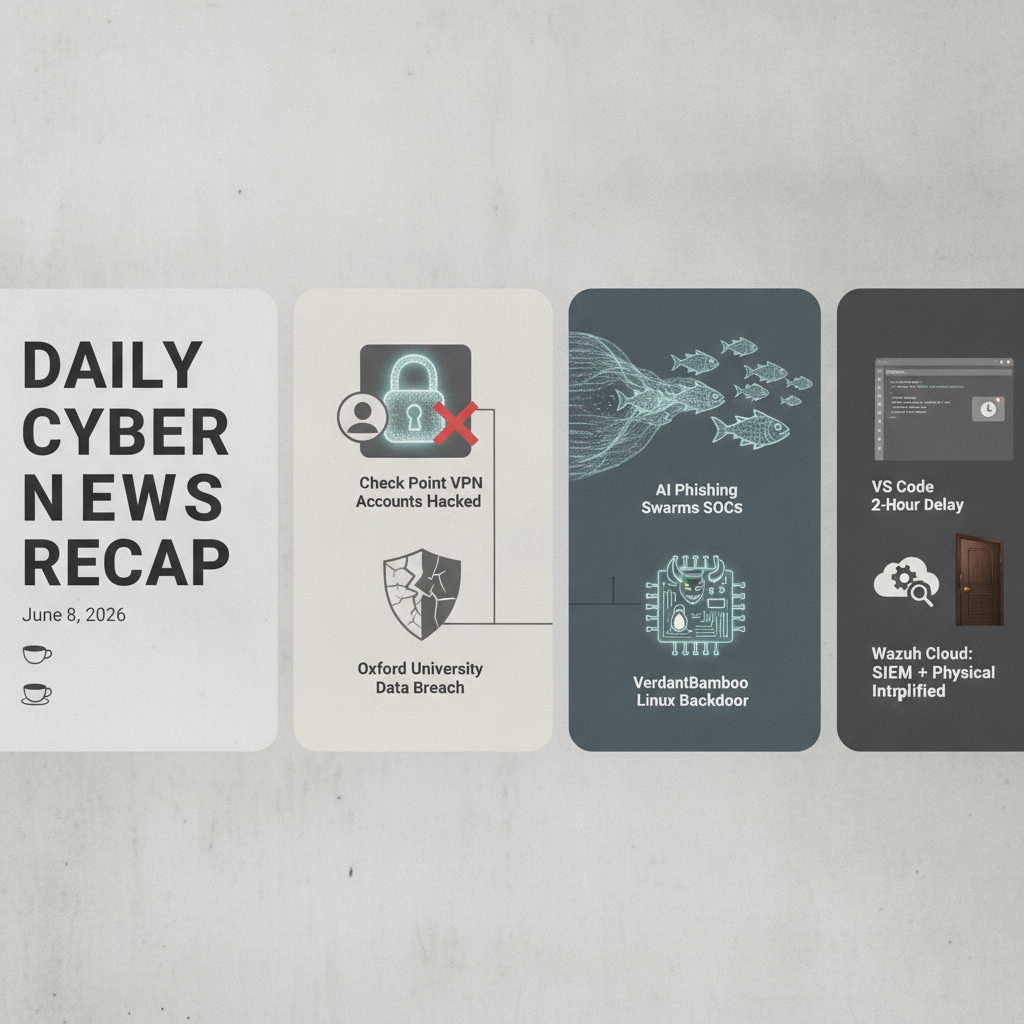
Daily Cybersecurity News Recap
June 8, 2026 ☕😑
Opening Scene
Well, well, well. Another Monday morning, another stack of breach disclosures, and another reminder that we’re all just one misconfigured AI chatbot away from chaos. 🎭 The weekend promised quiet. It lied. We’ve got VPN zero-days being weaponized by ransomware gangs, Instagram accounts getting yeeted into the void via Meta’s own support system, and threat actors who apparently read the same playbook we’ve been warning about since 2004. Grab your coffee—this is going to be one of those weeks. ☕🚀
🚨 DEFINITELY TAKE A LOOK
Check Point VPN Gets Zero-Day’d (And Qilin’s Already Dancing With It)
Check Point dropped a critical VPN vulnerability (CVE-2026-50751, CVSS 9.3) affecting Remote Access VPN and Mobile Access deployments, and—plot twist—threat actors are already actively exploiting it. The flaw is a logic flow weakness in certificate validation that lets unauthenticated attackers bypass authentication in IKEv1-configured setups, which is absolutely chef’s kiss for ransomware gangs like Qilin who are apparently using this to bypass your entire perimeter defense. If you’re running Check Point VPN, patches exist. Use them. Immediately. No, seriously. Now. 🔓💀
Sources:
– BleepingComputer: Check Point links VPN zero-day attacks to Qilin ransomware gang
– The Hacker News: Critical Check Point VPN Flaw Exploited to Bypass Passwords
Instagram’s 20K+ Account Takeover: When Your AI Support Gets Socially Engineered
Meta revealed that 20,225 Instagram users got their accounts hijacked when attackers weaponized Meta’s own AI-powered support system to reset passwords. Yes, you read that correctly. The company’s security feature became the attack vector. 🤖💔 This is what happens when you automate the last line of defense without actually thinking through whether bad actors can manipulate the automation itself. Users are mad, Instagram’s reputation took another hit, and somewhere in Menlo Park, someone’s explaining why this happened.
Source:
– BleepingComputer: Over 20,000 Instagram accounts stolen in Meta AI support hack
Oxford University Catches a Breach (From a Third Party, Of Course)
The University of Oxford disclosed a data breach affecting its CareerConnect career services platform after third-party provider Group GTI got compromised. Spoiler alert: nobody knows the full scope yet because it’s still being investigated. 🎓😩 This is the classic “trusted vendor becomes the weak link” story we’ve seen approximately 47 million times. Universities have notoriously lean security budgets and outsource to cut costs—then get surprised when those outsourced services become breach highways.
Source:
– BleepingComputer: Oxford University discloses data breach after careers platform hack
📋 YOU SHOULD PROBABLY REVIEW
AI-Powered Phishing Is Crushing Your SOC (And It’s Only Getting Worse)
Attackers have weaponized AI to generate convincing phishing emails and fake login pages at scale, and your Tier 1 analysts are drowning in false positives. 📧🌊 The volume game just became exponential. What used to take weeks to craft now takes minutes, and every polished message adds another case to review. Credentials get stolen while teams are buried under alert noise. This isn’t a new attack vector—it’s the old one on industrial-grade steroids. Your phishing detection needs serious augmentation, or prepare for Tier 1 burnout at scale.
Source:
– The Hacker News: AI Phishing Is Crushing SOCs with Alert Volume
VerdantBamboo’s Linux Backdoor Tour (Now With BSD Flavor!)
A China-nexus group called VerdantBamboo (also tracked as Clay Typhoon) has been deploying BSD variants of the BRICKSTORM backdoor plus PLENET and AGENTPSD malware against Linux appliances. 🐧💀 This is your friendly reminder that not all backdoors run on Windows, and infrastructure appliances are very much in the crosshairs. These are espionage tools in the hands of sophisticated actors, and they’re specifically targeting Linux systems—which means your network appliances, cloud infrastructure, and containerized environments are fair game.
Source:
– The Hacker News: VerdantBamboo Deploys BSD Variant of BRICKSTORM on Linux Appliances
UNC3753: Vishing + Physical Intrusions = Expensive Problem
A financially motivated threat group has been conducting data theft extortion campaigns against U.S. professional services, legal, and financial firms by combining old-school vishing (voice phishing) with actual physical intrusions. 📞🚪 This is what happens when social engineering meets shoulder surfing in the real world. Between January and May 2026, dozens of orgs got hit. The mix of digital and physical attacks makes detection harder because it’s not just about network monitoring anymore—it’s about training employees to recognize both. Attributable to UNC3753 per Google Mandiant and GTIG.
Source:
– The Hacker News: UNC3753 Used Vishing and Physical Intrusions in U.S. Data Theft Extortion Campaign
💡 INFORMATIONAL & GOOD TO KNOW
VS Code Adds a 2-Hour Extension Delay (Better Late Than Never)
Microsoft implemented a two-hour auto-update delay for VS Code extensions to catch malicious updates before they hit developers at scale. 🛡️⏰ Supply chain attacks targeting dev tools have been all the rage, so adding a window for detection and manual intervention makes sense. It’s not perfect—a determined attacker with 2 hours of runway can still cause damage—but it’s friction. Friction is good when you’re trying to disrupt automated attack chains.
Source:
– The Hacker News: VS Code Adds 2-Hour Extension Auto-Update Delay
Wazuh Cloud: Making SIEM Ops Less Miserable
Wazuh Cloud promises to reduce security operations complexity by managing infrastructure, automating scaling, and throwing AI at security analysis. 🤖📊 Alert fatigue is real. Hybrid environments are a nightmare. If you’re still managing on-premises SIEM infrastructure while drowning in hybrid cloud deployments, a managed solution might be worth evaluating. This is less “breaking news” and more “product announcement with teeth”—but addressing SOC overwhelm is genuinely important.
Source:
– BleepingComputer: Reducing security operations complexity with Wazuh Cloud
Anthropic’s Project Glasswing: Finding Vulnerabilities Is Easier Than Fixing Them
Anthropic launched Project Glasswing to help companies find security vulnerabilities using AI models. Early results? Lots of vulns discovered, very few actually patched. 🔍🤷 Bruce Schneier’s take: something doesn’t add up with the data, and Anthropic’s refusal to share details is… suspicious. The hype around AI vulnerability detection outpaces the actual utility when patches aren’t being deployed. Classic case
Leave a Reply